Wilson Blade 98 16x19 v10 Review
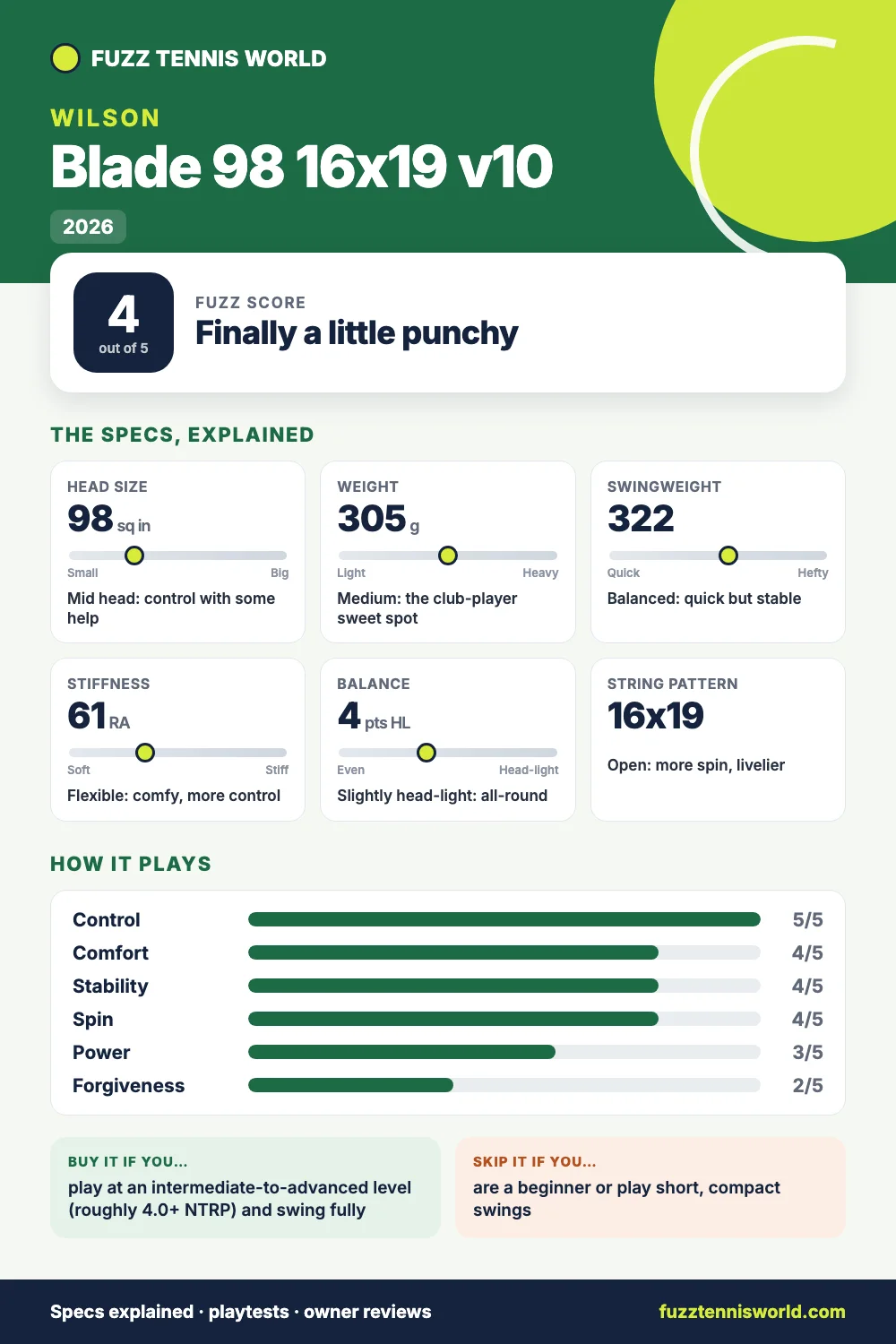
Yes, if you already swing fast and full.
Read the transcript
Wilson Blade ninety-eight, sixteen by nineteen. Version ten. Three hundred dollars. For 2026, Wilson finally gave the Blade a thicker, tapered beam. Testers say you can feel it: a bit more power, the same famous control. Tennis Warehouse's playtest team gave it eight point two out of ten, with top marks for comfort and stability. The catch? It's still a Blade. It wants a full, confident swing. One owner's advice to beginners: don't buy it. Another says the paint chips if you look at it wrong. Fuzz Score: four out of five. Precise, comfy, finally a little punchy. But what do I know? I'm just a tennis ball.
Reasons to buy
- Classic Blade control, now with a little more power from the tapered beam
- Comfortable for a control frame: RA 61, and comfort was the playtesters' top score (8.6)
- Stable and precise at net and on slices
Reasons not to buy
- Not forgiving: one owner warns beginners off it
- Some playtesters struggled to end points with it
- One owner reports paint chipping
Yes, if you already swing fast and full. The 2026 Blade 98 16x19 keeps what made the Blade famous (control, feel, comfort) and adds a little power and stability with a new tapered beam. If you're still learning, it'll punish you. Look at a 100 sq in frame like the Clash 100 or Pure Drive instead.
Overview
The Blade 98 16x19 is Wilson's best-known control racquet: a 98 sq in head, an open 16x19 pattern for spin, a flexible frame for feel. For its tenth version, Wilson changed the one thing it had kept for years, the flat 21 mm beam. The v10 is 21.5 mm at the tip and sides and 20.5 mm at the throat.
Thicker at the top means a bit more pop. Thinner at the throat is meant to keep it quick and feeling like a Blade. Everyone who has written about it so far agrees on the direction: slightly more power, still a control racquet.
How Fuzz reviews: he hasn't hit with it. He's a tennis ball; he's usually on the other end. This review is built from Wilson's and Tennis Warehouse's spec sheets, Tennis Warehouse's four-person playtest (June 2026), Tennis Express's review and the 8 owner reviews published so far. Every claim says where it came from. Our method
What changed from the Blade 98 16x19 v9
| Blade 98 16x19 v9 | Blade 98 16x19 v10 | |
|---|---|---|
| Beam | 21 / 21 / 21 mm, flat | 21.5 / 21.5 / 20.5 mm, tapered |
| Swingweight | 324 | 322 (about the same) |
| Stiffness (RA) | 62 | 61 (about the same) |
| Strung weight | 11.4 oz / 323 g | 11.4 oz / 323 g (about the same) |
| Material | Basalt / braided graphite | Braided graphite, StableFeel+ |
| Tolerances | Standard | Tighter weight, balance and swingweight tolerances |
| Carried over | FORTYFIVE° layup, Direct Connect handle | |
Tennis Warehouse strung specs for v9 and v10; v10 changes as described by Tennis Warehouse (22 Nov 2026). On paper, the numbers barely moved. The beam is the whole story.
Should you upgrade? If you like the v9's softer, more muted feel and you're happy with your power, no. A discounted v9 is still a great racquet. If you've wanted the Blade to hit a heavier ball, the v10 is the one testers and owners say does that.
What the specs mean for you
Low-medium, per Tennis Warehouse. A 98 head, 61 RA and 322 swingweight won't do the work for you.
The Blade's whole reason to exist. Every source agrees.
RA 61 is flexible for a modern frame (most sit in the mid-60s to low 70s).
Swingweight 322 with 4 pts head-light balance: quick at net, still stable.
16x19 is the open, spin-friendly pattern; not a spin monster like a Pure Aero.
A 98 sq in head needs clean contact. This is the one to think hardest about.
Our estimate, worked out from the specs against the other racquets in our database. Not a measurement; how it feels in your hand can differ.
What the testers said
Tennis Warehouse playtest, June 2026, 4 testers. Full breakdown on their review.
The four testers split. Chris loved it from the baseline and on serve: Pace, depth and spin all felt easy to generate.
But even he found he overhit when going for the corners, and preferred the 18x20 version for match play. The other three said it rallied well but they had to work harder to finish points.
Where they agreed: at net. Stable, quick and predictable on volleys, with good bite on slices and drop volleys. Tennis Warehouse's list of negatives says "nothing we could agree upon".
Tennis Express's review lands in the same place: more power and the most stability a Blade has had, without losing the control and feel.
What owners say
Tennis Warehouse customer reviews, April–August 2026, read 22 Nov 2026. Shown for context; not our score. Eight early reviews is a small sample, and early buyers tend to be fans.
- More power than earlier Blades4 of 8
The most repeated point. One long-time Blade user says it no longer feels underpowered next to the Radical, TF40 or Percept. - Control and precision3 of 8
"Super predictable", in one owner's words, so you can swing out. - Comfort2 of 8
One reports no arm pain; another rates comfort 8/10. - Not for beginners1 of 8
The same owner who loved it rated user-friendliness 5/10:if you are beginning tennis do not buy this
. - Paint1 of 8
Paint flakes/chips if you look at it wrong.
One report, but worth knowing.
Who it's for
Buy it if you…
- Play at an intermediate-to-advanced level (roughly 4.0+ NTRP) and swing fully
- Like to come to net or use a slice
- Want control and feel first, and a little help with power
- Have played a Blade before and wished it hit harder
Skip it if you…
- Are a beginner or play short, compact swings
- Want free power or a big sweet spot
- Want maximum spin (look at the Pure Aero 98)
- Love the v9's muted feel and don't need more pop
Fuzz Score breakdown
Specs
| Head size | 98 sq in |
|---|---|
| Length | 27 in |
| Weight | 10.8 oz / 305 g unstrung (Wilson) · 11.4 oz / 323 g strung (Tennis Warehouse; Wilson says 320 g) |
| Balance | 7 pts head-light unstrung, 32 cm (Wilson) · 4 pts head-light strung, 33 cm (Tennis Warehouse) |
| Swingweight | 322 |
| Stiffness | 61 RA |
| Beam | 21.5 / 21.5 / 20.5 mm |
| String pattern | 16x19 · mains skip 8T, 8H · one-piece |
| Tension | 47–57 lb |
| Construction | Braided graphite, FORTYFIVE° layup, StableFeel+, Direct Connect |
| Power level | Low-medium |
| Played by | Hubert Hurkacz, Katie Boulter (pros often play customised frames) |
| On Amazon | Sold pre-strung with Wilson Sensation 16, one listing per grip size |
Sources: Wilson AU/NZ product pages; Tennis Warehouse product page (22 Nov 2026). Where they differ, both are shown.
What we can't tell you
Some things only a racquet in your hand would show, so we won't pretend:
- How it feels against your current frame. Feel is personal; demo it if you can.
- How durable the paint is. One owner report so far isn't a pattern.
- How it plays with your strings. Amazon's version comes strung with Sensation 16; Tennis Warehouse's playtest used their own setup.
Blade 98 16x19 v10 vs the alternatives
| Racquet | Key specs | Choose it if |
|---|---|---|
| Wilson Blade 98 16x19 v10 | 98 sq in · 305 g · 16x19 · RA 61 | This review |
| Wilson Blade 98 18x20 v10 | 98 sq in · 305 g · 18x20 · RA 61 | You want even tighter control and flatter, more precise shots |
| Wilson Blade 98 16x19 v9 | 98 · 305 g · 16x19 | You like a softer, more muted feel and want to save money |
| Babolat Pure Strike 98 16x19 | 98 sq in · 305 g · 16x19 · RA 64 | You want a crisper, firmer feel and a bit more power |
| Tecnifibre TF40 305 16x19 | 98 · 305 g · 16x19 | You want a classic, connected control frame |
| Solinco Whiteout 305 | 98 · 305 g · 16x19 | You want a control frame with a crisp, direct response |
Closest racquets by specs, checked by an editor. Specs shown only for racquets in our database.
FAQ
Is the Wilson Blade 98 16x19 v10 worth it?
Yes for intermediate and advanced players who swing fully and want control and feel. At $299 it adds a little power and stability over the v9. Beginners should look at something more forgiving.
Is the Blade v10 better than the v9?
It's a little more powerful and stable, according to Tennis Warehouse's playtesters and most of the first owner reviews. The main change is the beam: 21.5/21.5/20.5 mm on v10 against a flat 21 mm on v9. If you love the v9's softer, more muted feel, a discounted v9 is still a fine buy.
Is the Blade 98 16x19 v10 good for beginners?
No. Its 98 sq in head and low-medium power level reward full, accurate swings. One owner rated its user-friendliness 5/10 and warned beginners not to buy it.
Should I get the 16x19 or the 18x20 Blade v10?
The 16x19 is the easier one to get spin and depth with. The 18x20 is tighter and more precise. One Tennis Warehouse tester preferred the 16x19 for hitting and the 18x20 for points because he overhit more with the 16x19.
What string tension should I use?
The recommended range is 47 to 57 lb. Start in the middle and adjust: lower for more power and comfort, higher for more control.
Is the Blade 98 v10 arm-friendly?
It's on the comfortable side for a control racquet: RA stiffness 61, and comfort was the playtesters' highest score (8.6/10). Two owners mention comfort or no arm pain. If you have an injury, ask a doctor or coach too.
Reader reviews
Sources and updates
- Tennis Warehouse, Blade 98 16x19 v10 product page: strung specs, price $299, 8 customer reviews (22 Nov 2026)
- Tennis Warehouse, Blade 98 16x19 v10 playtest review, June 2026
- Wilson Australia and New Zealand product pages: unstrung weight and balance, strung weight
- Tennis Warehouse, Blade 98 16x19 v9 product page: v9 specs
- Tennis Express, Blade 98 16x19 v10 review
- Amazon US listing B0G1V6KQ7L (seen in search results)
22 Nov 2026: evidence collected and published · Next check: when price, specs or owner reviews change, or when a new version lands.
Fuzz is a tennis ball with strong opinions and no arms, and our host. His reviews are checked by David Kowalski before publishing, and we never claim to have hit with a racquet we haven't.
How Fuzz scores · Editorial standards · Corrections